
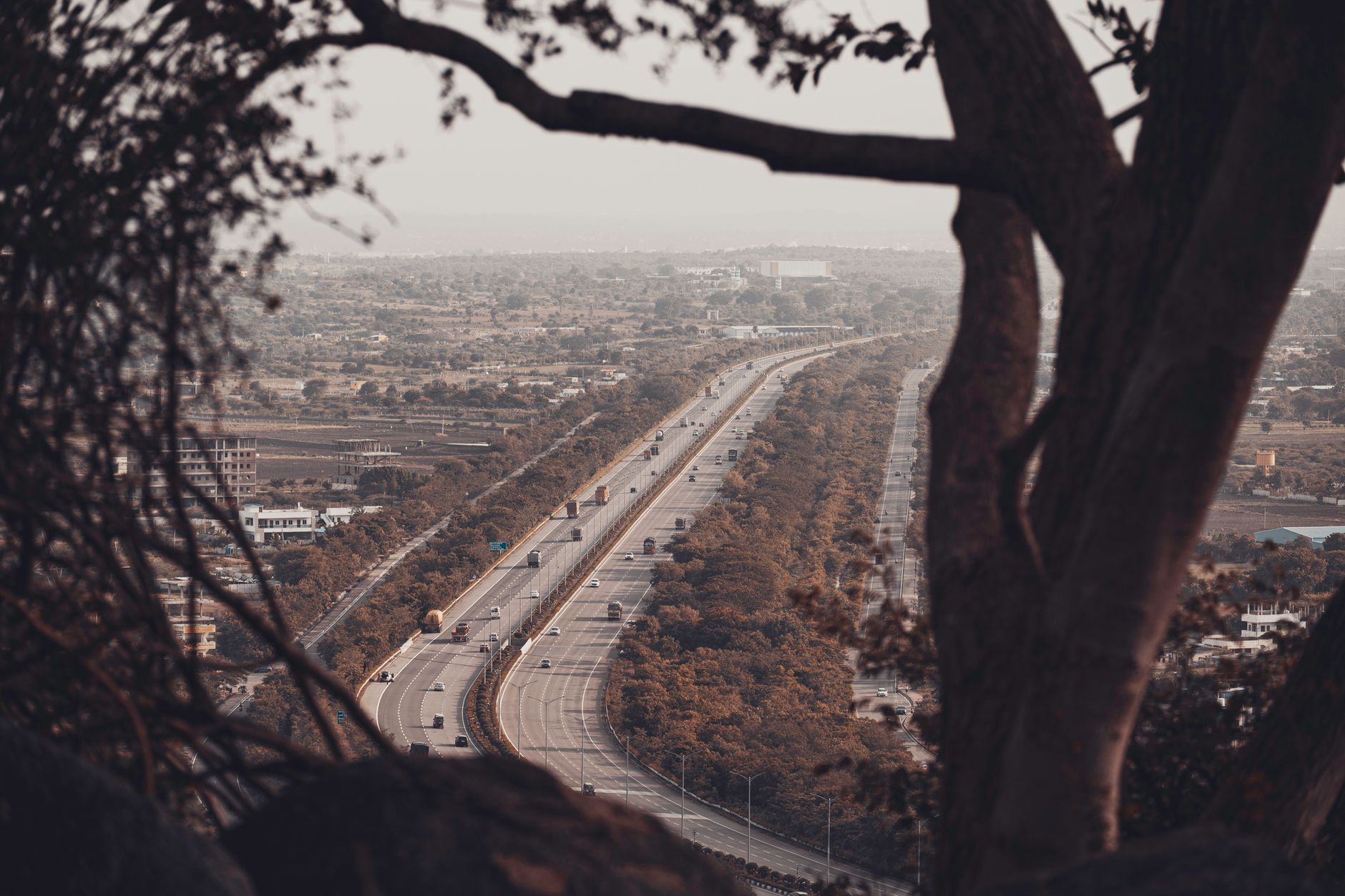
1. Mangar Bani ridge trail
Mangar Bani is the last real patch of native Aravalli forest inside the NCR, a sacred grove the villages have protected for generations, and the ridge above it is the honest number one. Park near Mangar village around 6:30am, walk twenty minutes up the fire line, and the view opens south over dhau forest with kites circling below eye level. On a clear December morning you can pick out the Faridabad water towers to the east and the Gurugram towers as a grey smudge to the northwest. It is quiet in a way nothing else on this list is.
The catch is access. There is no signage, no ticket, no toilet, and the last kilometre of road is broken. Come with a driver who has been before or the turnoff from Gurugram-Faridabad Road is easy to miss. Weekends bring mountain bikers from 7am onwards, which is fine company but not solitude. Skip it in June when the ground is bare and heat blurs everything past two kilometres. Best window is late October to early March, before 9am, ideally on a Tuesday when even the cyclists stay home.
2. Damdama Lake north bank at sunrise
Damdama sits 25 km south of Gurugram off Sohna Road, and the north bank is the view that pays back the drive. Come at 6am in winter and the water sits flat under mist while the Aravalli spurs on the far side turn pink for about twelve minutes. The picnic crowds arrive at 10am with speakers and paddle boats, so the whole trick is being gone by nine. A driver from Golf Course Road will quote about ₹1712 return with a two-hour wait, which is fair.
Rank it second because the view is genuinely good but the experience is compromised by everything the state government has built around it — a boating jetty, a rope park, a food court that opens at eleven. The lake itself has shrunk in the last decade and the far bank now shows exposed mud in April and May. Go in January or February after a rain, walk east along the bund away from the boats, and ignore anyone selling you a camel ride. Bring your own coffee; the stalls are dire.
3. Sohna hot springs road, the switchbacks above town
The old Sohna road climbs out of town in three tight switchbacks before flattening onto the plateau toward Alwar, and the second bend has a lay-by that looks straight back over the Sohna valley. You can see the mustard fields in February as a solid yellow sheet, the pink sandstone quarries cut into the ridge, and on the clearest winter days the outline of the Alwar hills forty kilometres south. It is roadside, which sounds bad, but the trucks are slow here and the noise dies within a minute of stopping.
Come by car — there is no other way — and time it for 4:30pm in December so the light rakes across the ridge from the west. The old Raj-era rest house at the top of the climb has been half-restored and does chai for a dollar. Do not stop at the hot springs themselves at the base of the climb; they are municipal, crowded and smell of sulphur without the reward. The view is the point, not the springs. Forty-five minutes from Golf Course Road on a Sunday morning.
4. The Leela's Farm terrace at Damdama
This one costs money but earns its place. The Leela's Farm is a working farmstay on the ridge above Damdama Lake, and non-residents can book the terrace lunch for about ₹4279 a head including access from 12pm to 4pm. What you get is a stone terrace at roughly 320 metres facing due west over the lake and the ridges beyond, with proper shade, good food and no picnic speakers. In February the mustard is out below you and the view is postcard-clean.
The reason it is fourth and not higher is that you are paying for a controlled version of what the top three give you for free. The food is genuinely good — a north Indian thali that runs to six or seven small dishes — and the staff will let you sit past your slot if the terrace is quiet. Book two days ahead through the property, drive yourself or take a taxi for around ₹2092 each way from Sushant Lok, and plan to be back in the city by six before the Sohna Road traffic locks up.
5. Aravalli Biodiversity Park, the western ridge
This is the view that surprises people who assume Gurugram has nothing green. The Biodiversity Park sits on 380 acres of reclaimed mining land off NH-48 between Guru Dronacharya and Sikanderpur metro stations, and the western ridge trail climbs to about 260 metres in twenty minutes. From the top bench you look west into the DLF phases and east over the restored forest, which after fifteen years of planting now feels genuinely wooded. Sunset is the moment; the skyline behind you lights up while the ridge below stays in shadow.
Entry is free, the park opens 5:30am to 8pm, and there are toilets and a small cafe near the main gate. It is fifth on this list because it is a city park, not a wilderness — you will hear NH-48 the whole time — but as a view you can reach in fifteen minutes from any Golf Course Road hotel, it has no competition. Weekday evenings are quiet. Weekends after 5pm bring the whole neighbourhood, which is charming in its own way if you like watching Gurugram unwind.
6. Manesar-Alwar road, the Karoi cut
Twenty minutes south of Manesar the four-lane widens and climbs through a low cut in the ridge near Karoi village, and there is a truck stop on the western side where the view opens across the whole Manesar valley back toward Gurugram. On a clear morning after monsoon you can see the entire DLF skyline as a distant cluster and the ridges rolling south into Rajasthan. It is the only view on this list where you get the city and the wild country in one frame.
It ranks sixth because it takes work — 45 minutes from Cyber City minimum, no facilities beyond a dhaba with acceptable dal and paratha for two dollars, and you are essentially standing at a truck stop. But if you are already driving to Neemrana or Sariska, pull in here for twenty minutes on the way back around 4pm and the light is remarkable. Skip in May and June when the heat kills any distance, and in July when the humidity blurs everything past a kilometre. October and November are the honest peak.
How to actually do these in a weekend
If you only have one morning, do Aravalli Biodiversity Park at sunrise — it is free, fifteen minutes from any Golf Course Road hotel, and gets you home for breakfast. If you have a full day and a car, string Mangar Bani at sunrise, breakfast in Faridabad, then Damdama north bank at midday before the crowds and Sohna switchbacks at sunset. That is a solid 90 km loop, about ₹5230 in taxi hire, and covers four of the six.
Skip the temptation to combine these with a mall stop or a spa afternoon — the light windows are tight and losing an hour to lunch at Cyber Hub means you miss the sunset. Bring water, a light jacket for December mornings when it can drop to 6°C on the ridges, and shoes that handle loose stone. None of these need a guide, but a driver who knows the Sohna and Mangar turnoffs will save you an hour of wrong turns.
Good to know
Questions, answered
Can I do any of these viewpoints without a car?
Only Aravalli Biodiversity Park realistically. It is a ten-minute rickshaw ride from Guru Dronacharya metro. All the others need a car or hired driver; the nearest bus stops are inconvenient and the last-mile roads have no rickshaws waiting. Budget ₹1712 to ₹2853 for a half-day taxi hire from central Gurugram.
What is the best month for Aravalli viewpoints?
Mid-November to mid-February. The air is clearest, temperatures sit between 8°C and 24°C, and the mustard fields around Sohna and Damdama flower in late January into February. October is second-best after monsoon washes the dust out. Avoid April to June when heat haze kills any view past two kilometres.
Is Mangar Bani safe to walk alone?
Yes in daylight, though it is a working village and the grove is sacred, so behave accordingly — no loud music, no picnics inside the bani itself, and ask before photographing people. Solo women should ideally come with one other person or a driver waiting at the trailhead. Leopards have been camera-trapped in the wider forest but sightings on the ridge trail are effectively zero.
Doing good is the business: every booking through Stay Gurugram funds one verified tonne of carbon removal — same room, same price, no markup.
Start your search