
Culture & sights
A heritage trail in Gurugram: the old city and its overlooked monuments
The glass-and-steel city hides 8 genuinely old structures — a Mughal-era stepwell, two forts, and a 400-year-old shrine — this walking and driving route links them across one long day.
What history Gurugram actually has
Modern Gurugram is 25 years old but the ground it sits on is not. The name itself refers to Guru Dronacharya of the Mahabharata, whose village grant supposedly lies under the current Sadar Bazaar. The region held small Rajput kingdoms, a Mughal-era salt-trade route through Farrukhnagar, a British-era railway junction, and a Baori-punctuated agricultural landscape until the 1990s. Almost all of that heritage still stands in fragments, and almost none of it is signposted. This trail assembles the fragments into one honest day.
The trail covers eight sites across about 45 km. It requires either a hired car for the day (₹5705-₹7607) or a self-driven vehicle; there is no realistic public transport spine for this route. October to March is the workable window; skip the whole plan in monsoon and in May-June heat. Start by 8am to finish the outdoor stops before midday. Total entry fees for the day run under ₹571; most sites are free and staffed by no one.
8:00-9:30 — Sheetla Mata Mandir and Sadar Bazaar
Start at Sheetla Mata Mandir, active since at least the 17th century and rebuilt several times. The original shrine is small but genuinely old and busy from 6am. Even if you are not there for devotion, the temple complex gives you the pilgrimage-town texture that got buried when the malls arrived. Entry free, shoes off, cover shoulders. Twenty minutes is enough unless you want the parikrama.
From the temple, walk or drive ten minutes to Sadar Bazaar and the old railway junction area. The Gurugram Junction station is late-19th-century British-era and still functions; the platforms and station master's building retain the period fabric. The bazaar streets around it hold the pre-boom commercial town — sweet shops, cloth merchants, small hardware stores — that Gurugram was before Cyber City. Breakfast here at any pavement dhaba for ₹190. This is the only urban-walking part of the day; enjoy it while the streets are still calm.
9:30-11:30 — Farrukhnagar and the salt-trade Baori
Drive 25 minutes west to Farrukhnagar, a Mughal-era garrison town founded in 1732 by Faujdar Khan under emperor Muhammad Shah. The town was built around the Sahibi salt trade and its walled core is still visible. The Sheesh Mahal palace stands in partial ruin, restored on the outside and mostly empty inside; entry is free and the caretaker will show you around for a ₹190 tip. The Delhi Gate and the old town walls survive in patches.
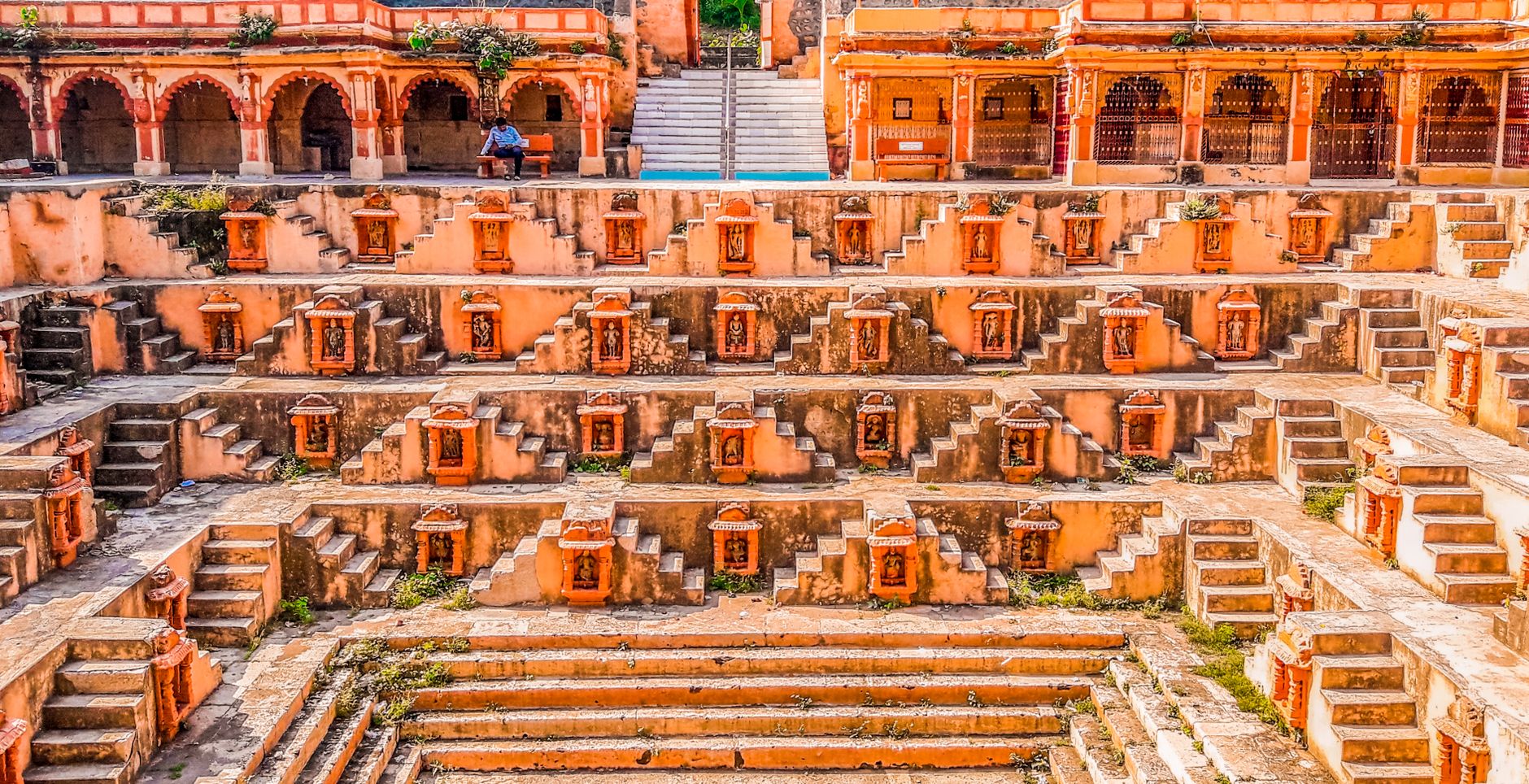
The star here is the Ghaus Ali Shah Baori, an octagonal stepwell built into the town wall. It descends about five levels and is dry now but structurally intact. Bring a torch for the lower levels. The Baori is genuinely one of the best-preserved Mughal stepwells in the Delhi region and receives almost no visitors — you may well have it entirely to yourself on a weekday. Allow an hour for the whole Farrukhnagar walk.
11:30-13:30 — Sultanpur wetland and lunch
Drive twenty minutes south to Sultanpur, which most guides list only for the bird sanctuary. The village next to it has a small 18th-century Baradari and the remains of a Bikaner-linked Rajput settlement. The wetland itself, though modern in its current form, sits on an old rain-water tank system that predates British engineering. Walk the short northern trail of the sanctuary — entry ₹285 — and you cover both the natural and the historical layers in an hour.
For lunch, either eat at the sanctuary's basic cafeteria (buffet about ₹761, functional) or push on to the Damdama Lake area 30 minutes east for a Haryana Tourism restaurant lunch. Neither is a food destination; the point is to break the day. If you carry a picnic, the shaded areas around the Sultanpur trail work well. Fuel up here if driving; the next stretch has fewer pumps.
13:30-15:30 — Damdama and the Aravalli edge
Damdama Lake was built as a British-era waterworks reservoir and remains one of the largest artificial water bodies in the region. The lake itself is silting up but the surrounding low hills are the eastern edge of the Aravalli range, geologically among the oldest mountains on earth (1.5-2 billion years). Walk the eastern shore for 30-40 minutes. Boat rides run ₹380-₹761 and are worth skipping unless you have kids.
The nearby village of Abheypur holds a Chauhan-era small fortification, more a walled village than a proper fort. The site is unmarked and the walk requires asking directions from villagers; expect friendly guidance in Hindi. If you are not comfortable with unstructured exploration, skip this and add extra time to the next stop. Everything past Damdama is either off the map or lightly documented, which is the point of a heritage trail in a city that pretends it has no heritage.
15:30-17:30 — Mangar Bani and the Aravalli sacred grove
Drive 40 minutes to Mangar Bani, the last patch of native Aravalli forest not cleared for farming. The grove is protected by village custom — the deity Gudariya Baba is said to punish anyone who cuts a tree here — rather than by government notification. The forest holds dhau, salai and native fig species that have otherwise disappeared from the Delhi-Gurugram region. The temple at the grove's edge is small; a ₹190 donation to the caretaker is customary.
The walking loop takes about 40 minutes and shows you what the whole Aravalli belt looked like before agricultural clearing and the last 30 years of urbanisation. Rock outcrops in the grove hold prehistoric cave art documented by ASI but not publicly accessible; ask locally about the current status. This is the most reflective stop on the trail — no ticket booth, no signage, no crowds, just the grove and the village that has kept it alive for centuries.
17:30-19:30 — Tauru, the Heritage Transport Museum
End at the Heritage Transport Museum in Taoru on the Delhi-Jaipur road, 30 minutes from Mangar. This is the only formal museum in the greater Gurugram region and covers Indian transport history from palanquins and bullock carts through vintage cars, colonial railway coaches, and mid-century Indian aviation. Entry is ₹761. It is a private collection assembled by Tarun Thakral and is genuinely well-curated across four floors and about 40,000 square feet.
For a heritage day, the museum works as a synthesis — you have spent the day walking through fragments of pre-modern and colonial-era Gurugram, and the museum ties the transport thread that connected all of it. Allow 90 minutes. The café is decent for tea and a light early dinner (₹951 a head). Closed Mondays. Cab back to central Gurugram takes 45 minutes; be on the road by 7pm to avoid the return traffic on NH-48.
Where to sleep for a heritage-focused visit
For a one-night stay, sleep in central Gurugram (MG Road or Golf Course Road) at a mid-range business hotel for ₹6656-₹13312. This keeps you close to Sadar Bazaar for a possible morning-two walk and puts you within 90 minutes of every site on the trail. Avoid Sohna Road and Sector 57 unless you are extending the trail south toward Mewat.
For a two-day heritage trip, split the second night at Neemrana Fort-Palace (about 90 minutes further southwest) at ₹17116-₹39937 per night. This lets you continue the heritage theme with an actual 15th-century fort stay and adds the Neemrana stepwell and Tijara Fort to the itinerary. The tariff at Neemrana includes access to all restored areas and terraces; book an upper-terrace room for the sunset view.
Good to know
Questions, answered
Are any of these sites accessible without a hired car?
Only Sheetla Mata and Sadar Bazaar are metro-accessible (HUDA City Centre station plus a short auto). Farrukhnagar, Sultanpur, Damdama, Mangar Bani and the Heritage Transport Museum all require a car. If you don’t want to self-drive, a full-day taxi with driver costs ₹5705-₹7607 and covers the whole loop with waiting time included.
How well preserved are these sites?
Variable. Sheetla Mata and Farrukhnagar's Baori are in usable condition. The Sheesh Mahal palace is partly restored, partly ruined. The Damdama-area fortifications are barely marked. Mangar Bani has no formal preservation, only village custom. Manage expectations: this is not the Rajasthan fort circuit. It is fragments, and the trail's value is in linking them.
Do I need a guide for these sites?
No formal guide service exists for most of them. Sadar Bazaar and Farrukhnagar have caretakers happy to explain in Hindi for a small tip (₹190-₹380). For Mangar Bani, ask at the village temple; a local elder will often walk with you. The Heritage Transport Museum has printed labels in English and audio guides for ₹285.
Doing good is the business: every booking through Stay Gurugram funds one verified tonne of carbon removal — same room, same price, no markup.
Start your search