
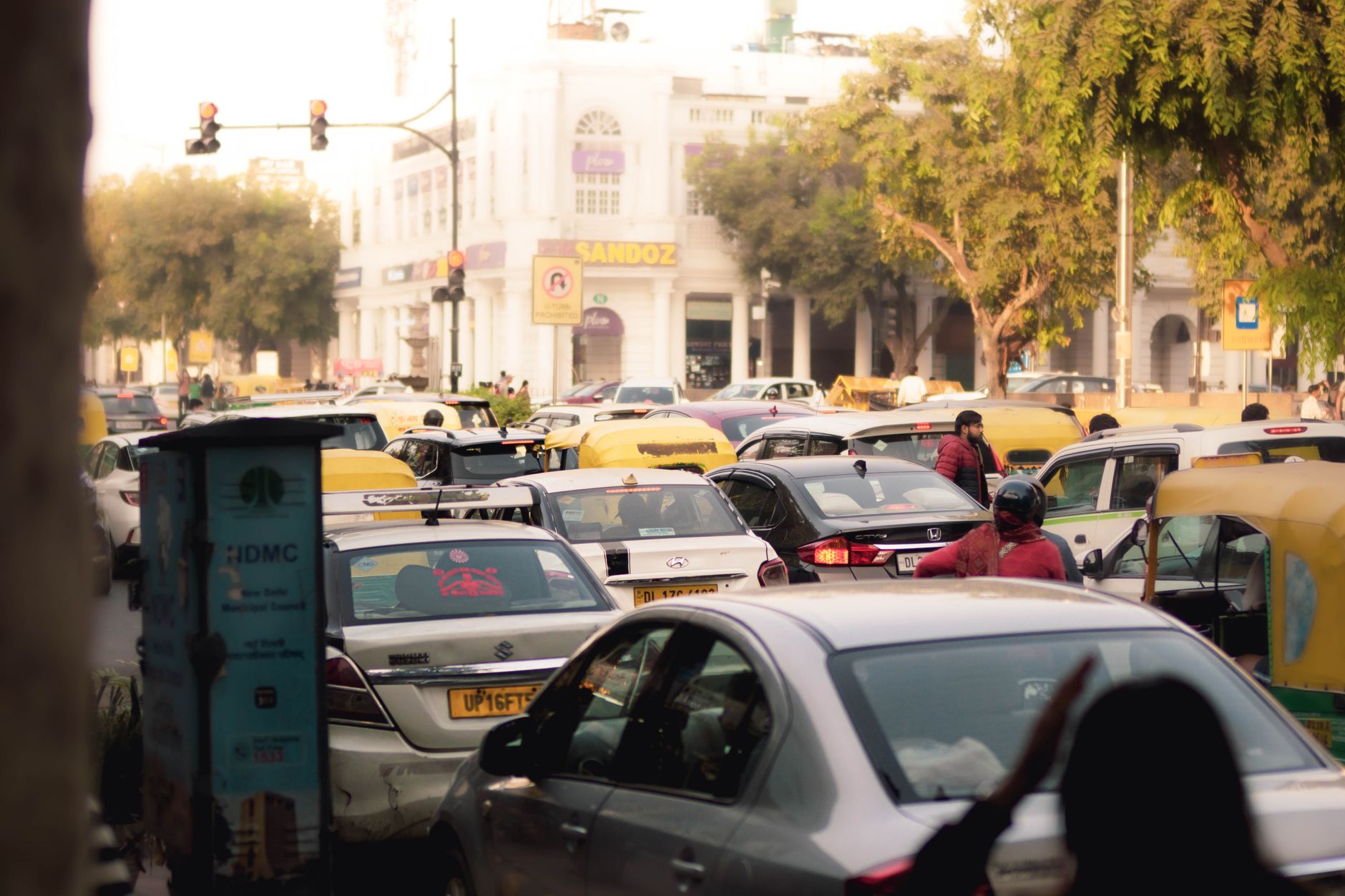
The Rapid Metro is a spine, not a network
The Rapid Metro runs 11.7 km from Sikanderpur (where it connects to the Delhi Metro Yellow Line) down through Cyber City and along Golf Course Road to Sector 55-56. That is the entire system. It does not go to Sohna Road, does not go to Golf Course Extension, does not go to Manesar, does not reach the airport, and does not touch Old Gurugram or Palam Vihar. If your hotel and your plans both sit on the Cyber City-Golf Course Road corridor, the metro is genuinely useful and costs under ₹95 a ride. Outside that corridor, treat it as one leg of a two-leg journey at best.
The interchange at Sikanderpur is the choke point everyone underestimates. Between 9-10am and 6-8pm the walkway between Rapid Metro and Yellow Line platforms is a slow shuffle, and the Yellow Line trains toward Huda City Centre run standing-room only. If you are heading into Delhi for a meeting, leave 20 minutes earlier than the map says. If you are coming back to Gurugram after 9pm, the Rapid Metro's last trains run around 11pm — check the day you travel, because timings shift with maintenance windows more often than the signage suggests.
Uber and Ola do the heavy lifting
App cabs are how residents actually move. Uber and Ola both operate across the whole city and out to the airport, with fares that run roughly ₹190-₹380 for a short hop within a sector, ₹475-₹761 Cyber City to MG Road, and ₹761-₹1331 from most of Gurugram to Terminal 3 at IGI. Surge pricing bites hardest between 8-10am, 6-9pm, and any time it rains — expect fares to double. If a driver cancels three times in a row, switch apps rather than keep trying; the two platforms have different driver pools and one is usually working when the other is not.
Two habits save real money and time. First, book Uber Auto or Ola Auto for trips under 4 km — an auto-rickshaw booked through the app is metered, honest, and often half the price of a car. Second, always check the number plate before you get in; cancellations and reassignments are common and getting into the wrong car wastes ten minutes on the phone with support. Drivers usually speak enough English to confirm a destination but not to navigate, so keep your pin dropped on the map and share the live location with someone at your hotel if you are travelling alone at night.
Auto-rickshaws off-app: know the rules
Street autos are everywhere in Gurugram and they do not run on the meter. You negotiate before you get in. A fair rate is roughly ₹57 per kilometre for a shared route, more like ₹95 per km if you want it to yourself and it is peak hour. Drivers will quote ₹285-₹380 for a ₹143 ride to anyone who looks foreign — smile, name a price 20% below what you think is fair, and walk away once if they refuse. They will usually call you back. If they do not, the next auto is thirty seconds behind.
Shared autos run fixed routes for ₹14-₹29 a seat and are how office staff and construction workers commute. Sohna Road, Old Delhi Road and the stretch from Huda City Centre to Sector 56 all have busy shared-auto lines. As a visitor you can use them, but you need to know the destination in Hindi or point at the route board, and you will be squeezed six people into a three-person bench. Fine for the experience and a short hop; not what you want with luggage or after dark.
Buses exist but are not for you
Gurugram has a city bus service run by GMCBL and inter-city Haryana Roadways buses that pass through on the way to Jaipur, Chandigarh and beyond. As a visitor you can ignore the city buses entirely — routes are poorly signposted in English, stops are unmarked, and the time you save on the ₹19 fare you lose ten times over standing at the wrong corner. The one exception is the DTC and Haryana Roadways buses to the airport from Bikaner House in Delhi, which are cheap and reliable if you are flexible on time.
Where buses matter is for day trips. HRTC and Haryana Roadways run frequent services from Dhaula Kuan and Kashmere Gate to Neemrana, Alwar, and Jaipur for ₹380-₹951 one way. These are worth using if you want to skip the driver-and-car cost of ₹7607-₹11411 for a day out. Book Volvo AC services rather than the ordinary red buses — the price difference is small, the seats are proper, and the arrival time is roughly what the schedule promises.
Your own driver: when it is worth it
Hiring a car with driver for the day costs ₹3328-₹5230 for an 8-hour, 80-km booking through a hotel concierge, and ₹4754-₹7607 through an app like Savaari or Zoomcar Chauffeur Drive. This is the right answer whenever you are doing three or more stops in a day, going to Sohna, Sultanpur, Damdama Lake, or making an out-and-back to Neemrana. The driver waits, handles parking, knows the shortcuts around the Iffco Chowk mess, and — critically — is your buffer against getting overcharged everywhere you stop.
What it is not worth: a single point-to-point ride within Gurugram, where an Uber does the same job for a fifth of the money. And do not confuse a day-hire driver with a tour guide — most drivers speak functional English and know the roads, but they are not trained to explain a monument or a menu. If you want commentary, book a guide separately through your hotel or a licensed operator; expect to pay ₹2377-₹3804 extra for a half day.
Walking: honest limits
Gurugram is not a walking city and pretending otherwise gets you hurt. Pavements exist in patches — Cyber Hub, Kingdom of Dreams plaza, the walkways around Ambience Mall — and vanish everywhere else. Crossing NH-48 or the Golf Course Road on foot means using foot-over-bridges where they exist and running for it where they do not. The one genuine walking stretch is inside a mall or an office complex; the other is Sultanpur Bird Sanctuary and the Aravalli Biodiversity Park, where you are on a proper trail with no traffic.
That said, short walks between adjacent buildings work fine. Cyber Hub to DLF Cyber City building 9 is 400 metres of clean pavement. The stretch from Galleria Market to the DLF Phase 4 residential blocks is walkable in daylight. Sector 29 is walkable inside its restaurant grid but not to get there. Rule of thumb: if it is under 500 metres and you can see the destination, walk. Beyond that, order an auto, because the heat, air quality, and open drains will win any argument you have with them.
The airport transfer: the one everyone gets wrong
IGI Airport is 12-25 km from most Gurugram hotels, but the time it takes has almost nothing to do with the distance. Cyber City to Terminal 3 in the middle of the night is 20 minutes; the same trip at 8am on a Monday is 75 minutes. Golf Course Extension to T3 at rush hour has hit 2 hours. Always budget for the worst-case time, especially on Fridays and Monday mornings, when a missed flight costs more than any ride ever will.
Three ways to do it, from best to worst. First, prebooked hotel car — ₹1712-₹3328, driver waits, no surge, tracks your flight. Second, Uber Premier or Ola Prime — ₹951-₹1712, works fine outside surge windows, driver may or may not know the correct terminal. Third, street taxi from the airport prepaid booth — ₹1141-₹1902, no negotiation, no app, useful only if your phone is dead. Whichever you pick, remember Terminal 3 has separate lanes for pickups and drop-offs and getting the wrong one costs a lap of the airport.
Good to know
Questions, answered
Is there a train from Gurugram to central Delhi?
Yes: the Yellow Line of the Delhi Metro runs from Huda City Centre in south Gurugram up through Sikanderpur, Sultanpur, Chhatarpur and into central Delhi at Rajiv Chowk. A ride from Huda City Centre to Rajiv Chowk takes about 55 minutes and costs roughly ₹71. It is faster than any road option in rush hour.
Can I rent a scooter or motorbike in Gurugram?
Technically yes through apps like Bounce and Vogo, but honestly no. Traffic is chaotic, lane discipline is a rumour, and helmets are lightweight token pieces. Even experienced motorbike travellers regret it here. If you want two wheels, take an auto-rickshaw — same speed, someone else takes the risk, and it costs about the same.
How do I pay for a Delhi Metro ride?
Buy a token at the station counter or vending machine for a single trip (₹29-₹95), or pick up a Delhi Metro Smart Card for ₹190 deposit plus loaded balance. The Smart Card gives a 10% discount and lets you skip the token queue, which matters at Rajiv Chowk. Contactless bank cards also work at gates on most lines now.
Is Rapid Metro included in the Delhi Metro fare?
No, it is a separate system with its own fare, though you use the same Smart Card. A Rapid Metro ride costs ₹24-₹43 depending on distance. If you change at Sikanderpur from Yellow Line to Rapid Metro, you tap out and tap in again — the two fares add together rather than integrating like a single trip.
Doing good is the business: every booking through Stay Gurugram funds one verified tonne of carbon removal — same room, same price, no markup.
Start your search